UK · UAE · International

UK · UAE · International
How the AED 20.5 Billion Metro Expansion Could Reshape Property Values, Investment Hotspots, and Eastern Dubai's Growth Through 2040.
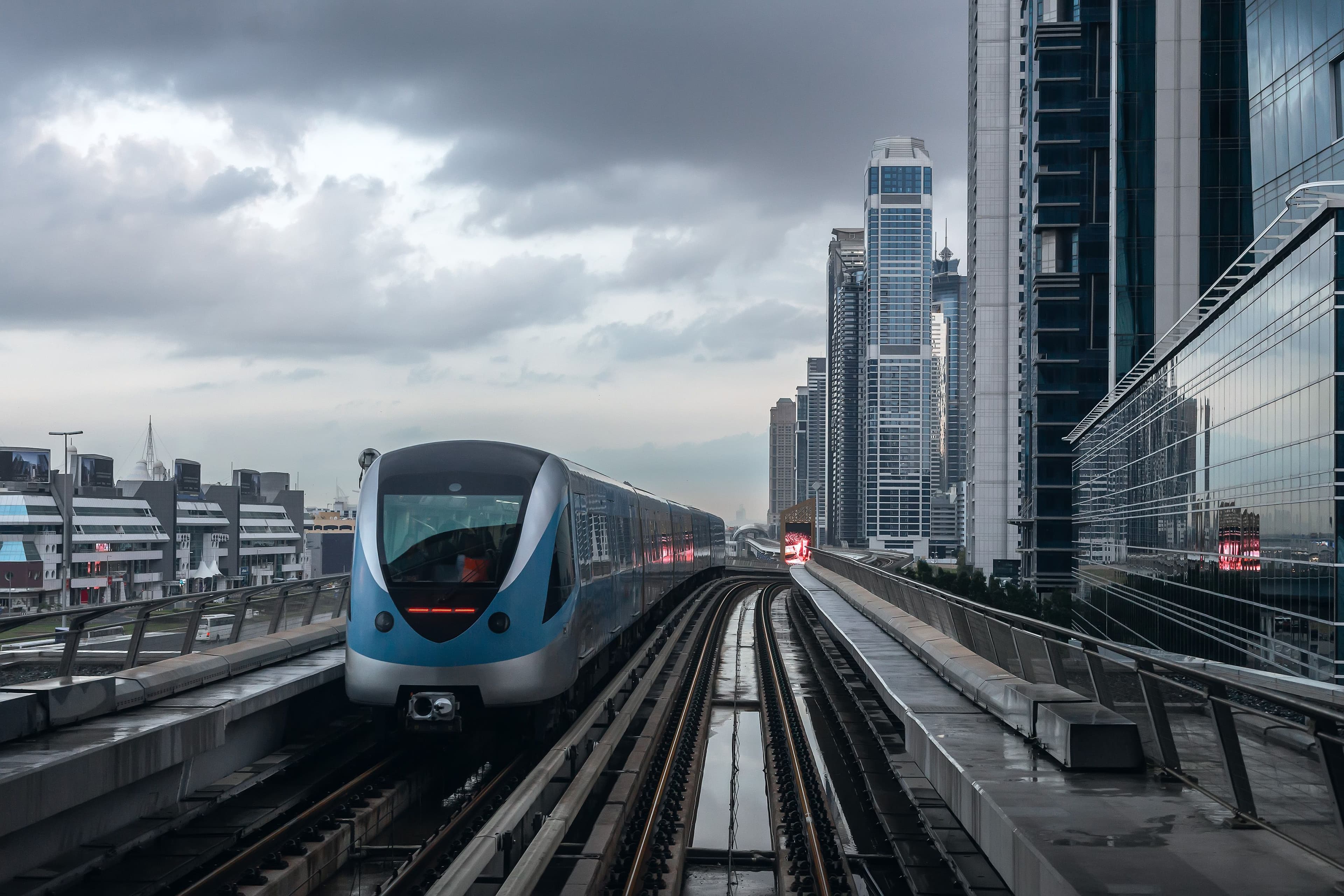
Every few years, Dubai makes an infrastructure decision that quietly resets its investment geography. The Red Line did it in 2009, turning Sheikh Zayed Road's station catchments into some of the most liquid property markets in the region. Route 2020 did it for the Expo corridor. The next chapter is already under construction: the Dubai Metro Blue Line, a AED 20.5 billion, 30-kilometre rail corridor that will, for the first time, connect the fast densifying residential districts of eastern Dubai, including the Dubai Creek Harbour, International City, Dubai Silicon Oasis, Mirdif, Al Warqa, Academic City and more directly into the metro network and to Dubai International Airport.
This report lays out the full picture: the official project facts, the latest construction milestones, the Dubai Land Department's record-breaking Q1 2026 market data, the corridor's community-by-community investment profile, and how the Blue Line fits into Dubai's rail vision through 2032 and the Dubai 2040 Urban Master Plan.
The Blue Line at a glance
The Blue Line is one of the largest infrastructure projects in the emirate's history and the first major extension of the metro network since Route 2020. Approved by His Highness Sheikh Mohammed bin Rashid Al Maktoum in November 2023, the project is being delivered by Dubai's Roads and Transport Authority (RTA) with a consortium of MAPA, Limak, and CRRC Hong Kong.
The official RTA figures are as follows:
Metric Figure
Project cost AED 20.5 billion
Total length 30 km (15.5 km underground, 14.5 km elevated)
Stations 14 (including three interchange stations)
Target opening 9 September 2029
Projected daily ridership 200,000 passengers by 2030; 320,000 by 2040
Estimated economic benefit More than AED 56.5 billion by 2040
Expected congestion reduction 20% along the corridors served
Population served by 2040 Approximately 1 million residents
The opening date is symbolic: 9 September 2029 will mark exactly twenty years since the original Dubai Metro launched on 9 September 2009. The line will connect the existing Red and Green Lines and provide a direct 20-minute journey to Dubai International Airport from the communities it serves.
Crucially, the RTA itself has stated that the project is anticipated to boost land and property values by up to 25% around metro stations. This project is one of the few occasions a government transport authority has put an explicit number on the real estate effect of a rail project.
Construction status in July 2026
For investors, the difference between an announced project and a delivered one is crucial. The Blue Line's construction record so far is strong and independently reported.
Construction commenced in June 2025, when the foundation stone was laid at the site of the future Emaar Properties Station in Dubai Creek Harbour. By November 2025, the RTA announced that overall construction had reached 10% completion, with more than 3 million work hours logged, over 260 deep foundations completed, more than 400,000 cubic metres of excavation underway at the International City station sites, and 11 traffic diversions implemented across 12 active construction locations. More than 500 engineers and 3,000 workers are deployed on the project.
By December 2025, an RTA project forum reported completion had risen to 12%, with more than 4.6 million work hours completed. The project is the first RTA rail scheme to integrate its own ready-mix concrete batching plants and precast yards, located at Al Ruwayyah 3 and International City, producing up to 12 viaduct segments and 12 tunnel rings per day.
The most significant milestone came in July 2026, when the RTA announced the completion of the first phase of tunnelling in just two months. The tunnel boring machine driving the project, named Al Wugeisha (after the pearl diver's basket), is 163 metres long, weighs more than 2,000 tonnes, and operates around the clock, averaging 13 to 17 metres of excavation per day with a peak capacity of 30 metres per day. More than 2,000 metres of tunnel have now been excavated, the machine has reached Dragon Souq Station (the first tunnelled station on the line), more than 800 metres of elevated viaduct have been completed, and the deep foundations of the landmark Emaar Properties Station are 100% complete.
The RTA's stated target is 30% overall completion by the end of 2026, with systems installation and testing expected through 2028 ahead of the 2029 opening. On every public checkpoint so far, the project is tracking on or ahead of schedule. This is completely compliant and consistent with the RTA's delivery record on the Red Line, Green Line, and Route 2020, all of which opened as planned.
Construction timeline
Date Milestone
Nov 2023 Blue Line approved
Dec 2024 Main construction contract awarded
Jun 2025 Foundation stone laid; construction commenced
Nov 2025 10% construction completed
Dec 2025 12% completed; 4.6 million work hours
Jul 2026 First phase of tunnelling completed
End 2026 Target: 30% complete
2028 Systems installation and testing expected
9 Sep 2029 Planned opening
The Main Route
The Blue Line is structured as two branches joined at a Y-junction beneath International City 1, which becomes an interchange in its own right.
The Creek branch begins at Creek station in Al Jaddaf, where it interchanges with the Green Line, then runs through Dubai Festival City, Dubai Creek Harbour, and Ras Al Khor before reaching International City. The Centrepoint branch begins at Centrepoint station in Rashidiya, interchanging with the Red Line, and passes through Mirdif and Al Warqa before joining the junction.
From International City, the combined line continues through International City 2 and 3, Dubai Silicon Oasis, and terminates at Academic City, with the main depot located beyond at Al Ruwayyah 3. The route also includes a dedicated 1.3 km metro bridge over Dubai Creek which is the city's most historic waterways.
The engineering centrepiece is the Emaar Properties Station at Dubai Creek Harbour. At approximately 74 metres tall, it will be the tallest metro station in the world, designed by Skidmore, Owings & Merrill (originally the architects behind the Burj Khalifa). This centerpiece covers 11,000 square metres with a capacity exceeding 160,000 passengers per day. For Dubai Creek Harbour, the station is not an amenity but a district's front door.
What does the DLD's Q1 2026 data show?
Infrastructure investment does not happen in a vacuum, and the Dubai Land Department's most recent quarterly release shows the strength of the market into which the Blue Line will open.
According to the DLD, Dubai's real estate sector recorded AED 252 billion in total transactions in the first quarter of 2026, a 31% year-on-year increase in value and a 6% rise in volume, and the strongest first quarter in the emirate's history. The quarter comprised 718,160 real estate procedures in total, of which 60,303 were transactions.
DLD Metric (Q1 2026) Figure Change YoY
Total transaction value AED 252 billion +31%
Total transactions 60,303 +6%
Real estate procedures 718,160 —
Investment value AED 173 billion +22%
Investment transactions 57,744 +7%
Total investors 48,448 +8%
New investors 29,312 +14%
Foreign investment value AED 148.35 billion +26%
Luxury segment investment AED 87.71 billion +26%
Two details in this data matter most for the Blue Line thesis. First, the 14% growth in first time investors signals that the market's expansion is being driven by a broadening buyer base rather than a narrow speculative pool. Second, foreign investment of over AED 148 billion in a single quarter, up 26%, confirms that international capital continues to view Dubai as a preferred destination. The DLD attributes this momentum to the structural framework of the Dubai Economic Agenda D33 and the Dubai Real Estate Strategy 2033, both of which position transit-oriented development as a core pillar.
The impact of metro stations on property values
The relationship between rail access and property values in Dubai is one of the best documented patterns in the market. Since the Red Line opened in 2009, properties within walking distance of stations have consistently commanded premiums over comparable stock without direct access, a pattern visible in DLD transaction data across multiple cycles.
For the Blue Line specifically, the RTA's own projection of up to a 25% uplift in land and property values around stations sets the official benchmark. Market reporting has already recorded early evidence of anticipation pricing: analysts covering the corridor have noted that Dubai Silicon Oasis saw per-square-foot prices rise on the order of 29% following the Blue Line announcement, as buyers positioned early.
Community-by-community outlook along the corridor Each district on the Blue Line has a distinct investment profile. The gross rental yields below are indicative ranges commonly cited in current market reporting; actual yields vary by building, unit type, and management quality.
Community
Investment Profile
Tier
Indicative Gross Yield
Dubai Creek Harbour
Luxury waterfront; capital appreciation play anchored by the world's tallest station
Tier 1
5–6%
Dubai Silicon Oasis
Technology hub with strong professional tenant demand; balanced yield and growth
Tier 1
6.5–8%
International City
High-volume affordable segment; the corridor's income engine with three stations
Tier 1
7–9%
Festival City
Established retail and waterfront district with airport proximity
Tier 2
5–6%
Mirdif
Family villa and townhouse market gaining metro access for the first time
Tier 2
5–6.5%
Al Warqa
Mid-market residential with new project activity and Safari Park adjacency
Tier 2
~5.5–6.5%
Academic City
Student and staff housing demand from the university cluster
Tier 2
6–7%
Ras Al Khor
Early-stage; long-term redevelopment potential as an industrial-to-mixed-use story
Tier 3
—
Dubai Creek Harbour is the corridor's flagship. It is a master-planned waterfront district positioned as a future downtown, and the Emaar Properties Station gives it the single most iconic piece of transit infrastructure in the network.
Similarly, Dubai Silicon Oasis is arguably the most balanced opportunity on the line. It combines a genuine employment base such as the technology park with a large residential population and carries the strongest early evidence of announcement-driven appreciation.
International City is the volume story. It is one of Dubai's most heavily transacted affordable communities, it receives three stations plus the interchange junction, and its gross yields of 7–9% make it the natural choice for income-focused investors. The trade-off is a competitive resale environment where unit selection and building quality matter enormously.
Mirdif and Al Warqa are the quiet beneficiaries. These are established, family-oriented communities that have never had metro access; first-time connectivity is historically where the largest relative accessibility gains and the largest relative value adjustments occur.
Academic City offers a specialised play on purpose-built student accommodation, a segment with structural undersupply. Ras Al Khor is the long-duration option: currently industrial in character, adjacent to the wildlife sanctuary, and flagged for future redevelopment, it suits patient capital comfortably with a longer and less certain timeline.
The Gold Line and the 2040 horizon plan
The Blue Line should not be evaluated in isolation, because Dubai has made clear it is one phase of a much larger rail programme aligned with the Dubai 2040 Urban Master Plan. The city framework that targets a "20-minute city" in which residents can reach more than 80% of daily services within a 20-minute journey is commendable.
When the Blue Line opens in 2029, RTA figures indicate the metro-and-tram network expands from 101 km and 64 stations to 131 km and 78 stations. But the bigger signal came on 22 April 2026, when Sheikh Mohammed bin Rashid announced the Dubai Metro Gold Line at AED 34 billion (around US$9 billion), the largest transport project in the emirate's history.
The Gold Line will run 42 km entirely underground with 18 stations, from Al Ghubaiba in Old Dubai to Jumeirah Golf Estates, passing through 15 strategic areas and strengthening connectivity to 55 major real estate developments currently under construction. It will interchange with the Green Line at Al Ghubaiba, the Red Line at Business Bay and Jumeirah Golf Estates, and with Etihad Rail at Meydan and Jumeirah Golf Estates, and it is designed to serve roughly 1.5 million residents, carrying up to 465,000 daily passengers beyond 2040.
Tenders are being issued in 2026, contract award is expected in 2027, and the target opening is 9 September 2032 after which the metro network reaches approximately 162 km and 85 stations.
For the Blue Line corridor specifically, the projected numbers by 2040 are 320,000 daily passengers, around one million residents in the served districts, and cumulative economic benefits exceeding AED 56.5 billion from time savings, fuel savings, and accident reduction. Infrastructure of this scale is a statement about where the city intends its population, employment, and value to concentrate. The eastern corridor served by the Blue Line is being deliberately upgraded from a collection of road-dependent suburbs into an integrated, transit-connected urban zone under a published timetable.
The questions serious investors should be asking
Big numbers make good headlines. They don't make investment decisions. Before committing capital anywhere along this corridor, below are some questions that determine outcomes.
Where is real demand coming from? On this corridor, demand is anchored by identifiable drivers: the technology employment base in Silicon Oasis, the university population in Academic City, airport-linked workers around Festival City and Centrepoint, and the affordable-housing population of International City. That is fundamentally different from demand manufactured by marketing.
Which locations offer long-term growth rather than short-term hype? Communities gaining metro access for the first time to Mirdif, Al Warqa, International City, Silicon Oasis, Academic City undergo a permanent change in their utility and not in their sentiment.
What makes a project strong five or ten years from now? Walkability to the actual station location, build quality that will still compete when the line opens, and supply discipline in the immediate catchment. Dubai's pipeline exceeds 110,000 new residential units in 2026 alone. It has well-located, well-managed assets that have shown pricing resilience.
How strong is the resale market, and is there a clear exit? Q1 2026 data shows a deep and liquid secondary market for instance, resale villa prices rose 16.2% year-on-year and resale apartments 6.3%. Not every property should be sold the same way or at the same time. Your selling strategy should depend on the type of property and its location.
Construction timelines can slip, even with the RTA's strong record. The RTA's 25% value-uplift figure is a projection, not a guarantee, and it describes station-adjacent land broadly rather than any specific building. Dubai's supply pipeline is substantial, and yield compression is possible in high-volume communities if deliveries cluster.
The Q1 2026 record was set and remains a factor in global capital flows. And metro-driven appreciation accrues unevenly: units a two-minute walk from a station and units a twenty-minute walk from the same station are different investments wearing the same postcode.
These risks are manageable through selection, not avoidable through timing. This is exactly why the quality of advice matters more than the speed of access.
Working with a specialist advisor
Navigating an infrastructure-led corridor like the Blue Line is precisely where specialist advice earns its keep, and it is the approach firms like Haus of Estate have built their practice around.
When asked why they are expanding internationally at a time when so many markets feel uncertain, their answer is simple: because clients aren't just looking for properties, they're looking for trusted advice.
Anyone can share the latest off-plan launch or send a price list; what matters is understanding the bigger picture (where real demand is coming from, which locations offer long-term growth rather than short-term hype, how strong the resale market is, and whether investors will have a clear exit strategy when the time comes).
Haus of Estate invests in knowledge before asking clients to invest their money, continually building relationships with trusted developers, local partners, and industry experts across the UAE, the UK, Saudi Arabia, and other emerging destinations because buying a property is easy, but making the right investment takes insight, research, and honest advice that puts the client's interests first.
Written by