UK · UAE · International

UK · UAE · International
How property buyers can secure 10 years of renewable UAE residency through a AED 2 million Dubai investment — plus the latest 2026 visa updates.
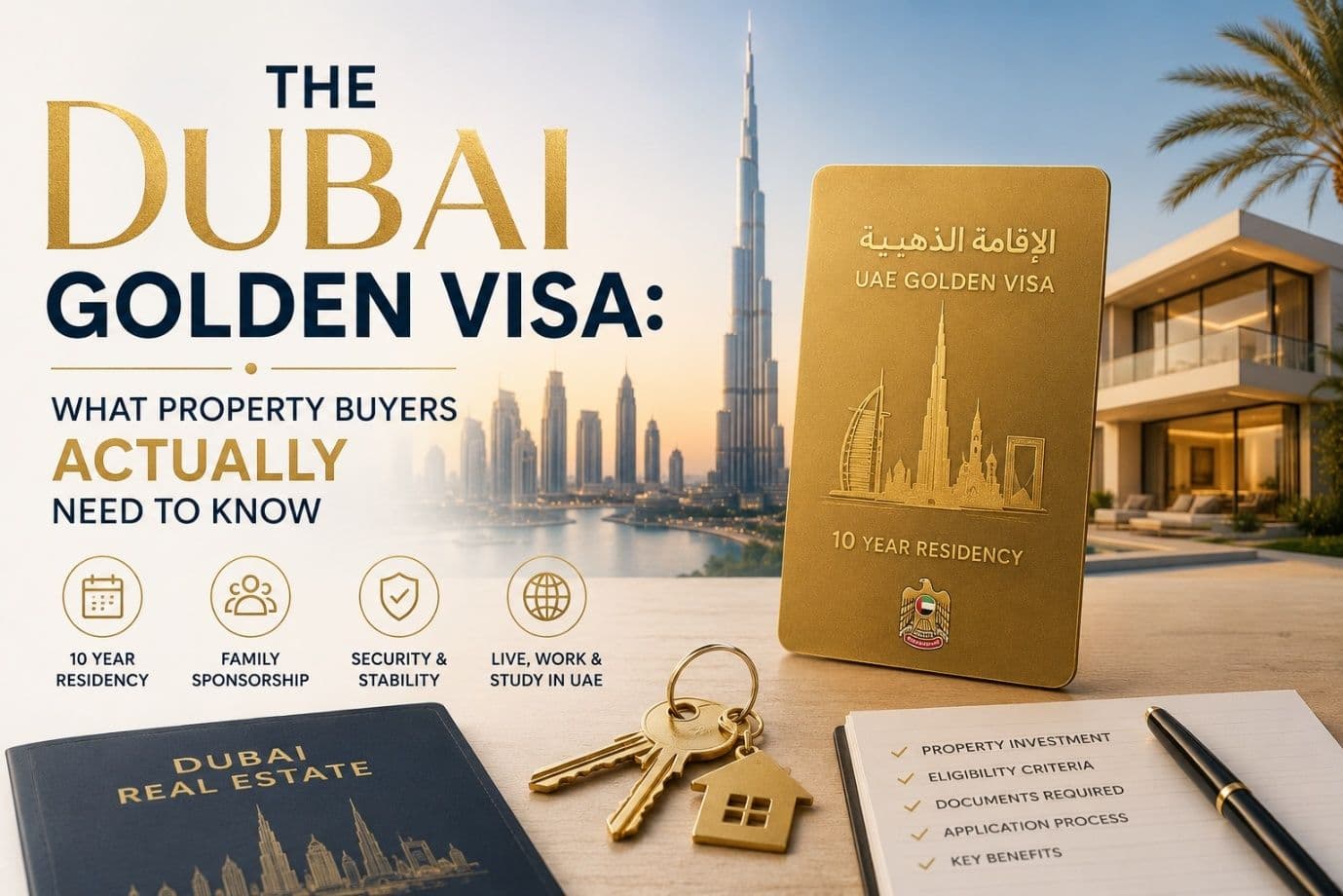
Buying real estate is something international investors were already doing in Dubai anyway. Considering the buyer psychology and the city’s population growth, Dubai is now viewed as a permanent home, not just as an investment. Over the recent years, the Golden Visa has given the country much more valuable outcomes attached to it. The real estate sector ended up becoming the most lucrative route into the UAE system.
The Golden Visa, the UAE's long-term residence visa, granted for either 5 or 10 years, has become one of the most powerful forces in Dubai real estate. Depending on the category, it can be renewed as long as the eligibility criteria continue to be met. It doesn't depend on an Emirati sponsor, an employer, or a local partner. So, instead of tying residence status to a job contract, it sits alongside other Golden Visa routes for entrepreneurs, top students, investors, scientists, and outstanding professionals, where the property route is arguably the most straightforward for international buyers, mainly dependent on and earned through what someone contributes or invests. This arrangement lasts for years rather than renewing annually around an employer’s goodwill.
For property buyers, the equation is simple. Buy a qualifying property worth at least AED 2 million or more in the real estate sector, and you or your family can qualify for 10 years of renewable UAE residency, i.e., a decade of stable, sponsor-free residency in one of the most dynamic cities.
The UAE government lets visa holders live, work, or study in the country with long-term capital benefits while enjoying a set of exclusive privileges reserved for long-term residents.
Dubai has spent the last decade building a case for itself as one of the leading places in the world to hold property without income tax or capital gains tax and yet have world-class infrastructure and a lifestyle that draws investors from every continent.
You need to hold real estate worth AED 2 million or more, at least one unit or several combined to actually own it, not merely have signed an intention to buy. If your property involves a bank, the relevant local authority needs to approve that lender, and you’ll be requested to produce the bank’s no objection letter to your residency application.
What many buyers need to be aware of is that every qualification value is officially recorded by the Dubai Land Department and not the price a broker quoted during negotiations. Two buyers may pay similar amounts for similar properties but get different results because the registered purchase price or official valuation is different. If a property's official value is higher than expected, it may fall on the other side of the eligibility threshold.
With regard to family, spouses, children, and, in some structures, parents can be added to the application once the primary investor's eligibility is confirmed. Unlike employment-sponsored visas, dependents generally do not require separate financial justification based on the sponsor's salary.
A few conditions run, such as for mortgaged properties; the applicant needs a No Objection Certificate from the bank. For off-plan purchases, the unit must be at least 50% complete with 50% of the purchase price already paid, and the developer must be approved by the relevant local authority. Comprehensive health insurance for the applicant and their family is also a standing requirement for the duration of the stay.
Set the visa aside for a moment, and the underlying property case isn't just a residency outcome sitting on top of a purchase. It is a residency attached to an income-producing asset in a market with no property tax, no capital gains tax, and no tax on rental income. With average gross yields around 7% for apartments in many Dubai communities, a AED 2 million qualifying property can generate meaningful annual income — a level that is difficult to find in most mature property markets. Layer a 10-year, sponsor-free residency on top of that, and the property purchase becomes more like securing your family's long-term base in the UAE.
For many buyers it is a family, a business, or simply a lifestyle choice genuinely yielding meaningful residency rights and paving the way for the Golden Visa property route to become one of the more durable reasons to choose Dubai over competing markets, even during economic times when property prices elsewhere look comparatively cheap.
It's also worth knowing that the UAE offers residency routes beyond property altogether — namely the Green Visa and the Blue Visa. These aren't property-linked and work differently from everything above: the Green Visa is a 5-year, self-sponsored visa for freelancers, skilled employees, and business investors, tied to employment or a stake in a company rather than real estate, while the Blue Visa is a 10-year visa reserved for individuals with a strong track record in environmental and sustainability work. The requirements for each are quite different from one another and from the property-based visas, so they're best treated as separate options rather than variations of the same route.
The 10-year Golden Visa isn't the only property-linked residency option. Dubai also offers a renewable 2-Year Investor Property Visa for owners of completed residential property, and it has recently become far more accessible. The previous AED 750,000 minimum has been dropped for sole owners, so a single applicant can qualify regardless of the property's value, as long as the title deed is fully registered and the unit is completed — off-plan properties don't count.
This update came into effect towards the end of April 2026: single owners can now apply without a minimum property value, while joint owners must meet the minimum share requirement of AED 400,000 per owner.
| Route | Minimum property value | Property status | Duration & renewal |
|---|---|---|---|
| 10-Year Golden Visa | AED 2 million+ | Ready, or off-plan at least 50% complete and 50% paid | 10 years, renewable |
| 2-Year Investor Visa | No minimum for sole owners; AED 400,000 share for joint owners | Completed residential only (off-plan excluded) | 2 years, renewable |
None of these processes are complicated once you understand the regulations and requirements well. However, norms are reviewed periodically, and details such as documentation lists, precise thresholds for entrants, or insurance requirements can keep changing or modifying as per the regulations.
If you'd rather not manage that verification alone, Haus of Estate can walk you through where things currently stand, match you with properties that will actually qualify, and stay involved through banking, developer coordination, and the final visa application — so the property purchase and the residency outcome move forward together instead of becoming two separate, disconnected projects.
This article is intended as general information and does not constitute legal, tax, or immigration advice. Golden Visa eligibility criteria are subject to change by the relevant UAE authorities.
Written by